
Last month marked a significant milestone for Amanda and me – our 16th wedding anniversary, which also happens to represent 16 years of business partnership. We celebrated with a quick trip to Sydney (don’t worry, I was back for Sunday open homes). The preparation for that trip involved plenty of farmers walks – not for fitness, but to build up strength for carrying shopping bags. When I asked about the budget, Amanda’s response was simple: “when I stop, I stop.” I knew I’d need serious distraction strategies.
This dual role as life and business partners brings unique benefits and challenges. The upside? You’re genuinely in it together, sharing both victories and setbacks. The downside? Drawing boundaries between home and office becomes nearly impossible. This experience has given me deep insights into what makes partnerships work – and more importantly, what makes them fail.
Complementary Roles: Playing to Your Strengths
The primary reason most real estate partnerships struggle or fail is simple: both parties want the spotlight. In an industry filled with personalities competing for attention, role clarity becomes crucial. Research from Harvard Business School shows that teams with clearly defined complementary roles are 67% more likely to achieve their performance targets.
Behind every successful real estate agent is someone more organised than the agent themselves. In our business, I focus entirely on the transaction side – listing, showing, and selling properties. Amanda handles process, delivery, and leadership. While my name might be on the door, I’m definitely not the boss. This division isn’t just practical; it’s strategic.
According to leadership expert Patrick Lencioni, successful teams require what he calls “complementary skill sets and natural working styles.” When team members try to duplicate rather than complement each other, conflict and inefficiency inevitably follow.
Attention to Detail: The Foundation of Trust
Most agents are naturally social and enjoy the relationship side of the business. However, this extroverted confidence often masks a critical weakness: lack of attention to detail. But in today’s market, “she’ll be right” doesn’t cut it anymore.
Detail matters because trust is built in the small moments. Clients may not notice when every detail is perfect, but they’ll certainly remember when something goes wrong. A study by Edelman Trust Barometer found that 73% of clients will switch service providers after a single negative experience involving poor attention to detail.
Having a detail-oriented partner isn’t just helpful – it’s essential. This person becomes your quality assurance, ensuring contracts are flawless, deadlines are met, and nothing falls through the cracks.
Emotional Support: Weathering the Storm Together

Real estate is brutal. Talk to anyone who tried and didn’t succeed, and they’ll tell you about the constant rejection and emotional toll. I was recently asked during a presentation: “How do you deal with all the rejection?” My honest answer: “You don’t deal with it – you just move on.”
But here’s the reality: nobody performs at 100% capacity all the time. Even the most successful agents have rough patches, and that’s where a good partner becomes invaluable. They can spot when you’re in a slump and step in with encouragement, take on extra responsibilities, or simply remind you why you’re in this business.
Research from the American Psychological Association shows that professionals with strong workplace support systems are 31% more productive and three times more likely to stay engaged during challenging periods. Everyone needs a cheerleader, especially in a rejection-heavy industry like real estate.
Shared Accountability: No Blame Game

Too often, partnerships become exercises in blame-shifting. “I thought Joe was handling that.” “I asked Joe to organise that.” “Joe was supposed to follow up.” This finger-pointing destroys trust and effectiveness faster than almost anything else.
Strong partnerships operate on shared accountability. When something goes wrong, both partners take responsibility for the outcome. This isn’t about diluting individual responsibility – it’s about creating clear ownership while maintaining collective accountability for results.
As business researcher Jim Collins notes in “Good to Great,” high-performing teams consistently demonstrate what he calls “the window and the mirror” principle: they look out the window to credit others for success and in the mirror to accept responsibility for failures.
The real estate industry will always be challenging, but with the right team approach, those challenges become manageable – even advantageous. After 16 years of partnership, I can confidently say that while two heads aren’t always better than one, two complementary skill sets definitely are.
The Wellington Market

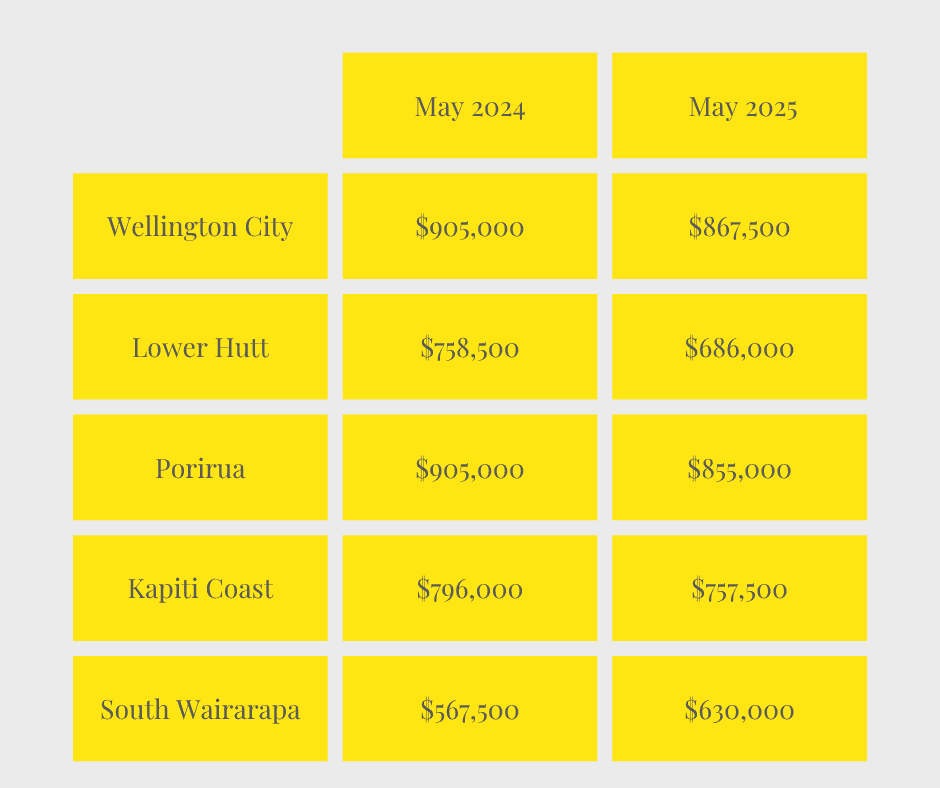
The local market has been challenging lately. After a promising first quarter, we’ve seen momentum slow significantly. Recent statistics indicate a 5.5% drop in property values over the past 12 months – disappointing news for our sellers and agents!
Interestingly, while this should theoretically create opportunities for buyers, we’re not seeing them capitalise on these conditions. This hesitation suggests that market psychology, rather than just economics, is driving current behaviour.
For both buyers and sellers, this environment makes professional guidance more valuable than ever. Navigating uncertainty requires experience, local knowledge, and yes – a strong team approach.
Wellington Market Quick Stats
What’s on in Welly?

Ed Gamble – Hot Diggity Dog, The Opera House, 11 June 2025
British comedian and foodie offers up a feast of comedy for Wellington audiences.
In his latest show, ’Hot Diggity Dog’, Ed Gamble goes to work in the kitchen. He’s minced a load of meat (thoughts), piped it into a casing (show), and now it’s coming to your favourite bun (The Opera House). Prepare for all your classic Gamble ranting, raving, and spluttering.
Ed Gamble has been described as “mesmerically funny and original… consistently eye-wateringly hilarious”. His signature style of mixing food and laughs always leaves audiences in stitches (and slightly peckish).
Black Ferns and All Blacks double-header, Sky Stadium, 12 July 2025

A grand rugby double-header — Black Ferns and All Blacks face international foes.
First up in women’s rugby, the Black Ferns face Australia in the O’Reilly Cup. This will be the last opportunity for Kiwis to cheer on the Black Ferns before they head off to the 2025 Rugby World Cup in England. That match is closely followed by the men’s game. In the July Series, the All Blacks take on old foes France. They aim to protect a proud unbeaten record against the Tri-Colours in Wellington that stretches back seven Tests to 1961.
Wairarapa Festival of Christmas, Greytown, 27 June-26 July 2025

Greytown is getting ready for one of the country’s happiest mid-winter celebrations. The Wairarapa Festival of Christmas is an extravaganza blending northern hemisphere charm with Kiwi flair. The month of festivities includes lights, laughter, and fun for all ages. This year’s theme, ‘Christmas Carnival’, applies to events including a Light Up Tractor Parade, Illumination Night Walk, and Kids Circus School Programme. There are also street parties, house tours, live music, and fireworks.
The main street in Greytown provides the hub for many activities across the four weeks. It will offer twinkling lights, themed shopfronts, delicious street food, and live entertainment. The mid-winter Christmas magic will be enhanced by the promise of a special snow delivery, too. Get ready to have a cracker of a celebration.
Click here for all the details
Meet the Ben Stevens & the Team
If you, or anyone you know, could benefit from a considered market assessment by Wellington’s only licensed agent and registered property valuer, please do not hesitate to call. We are always happy to help.